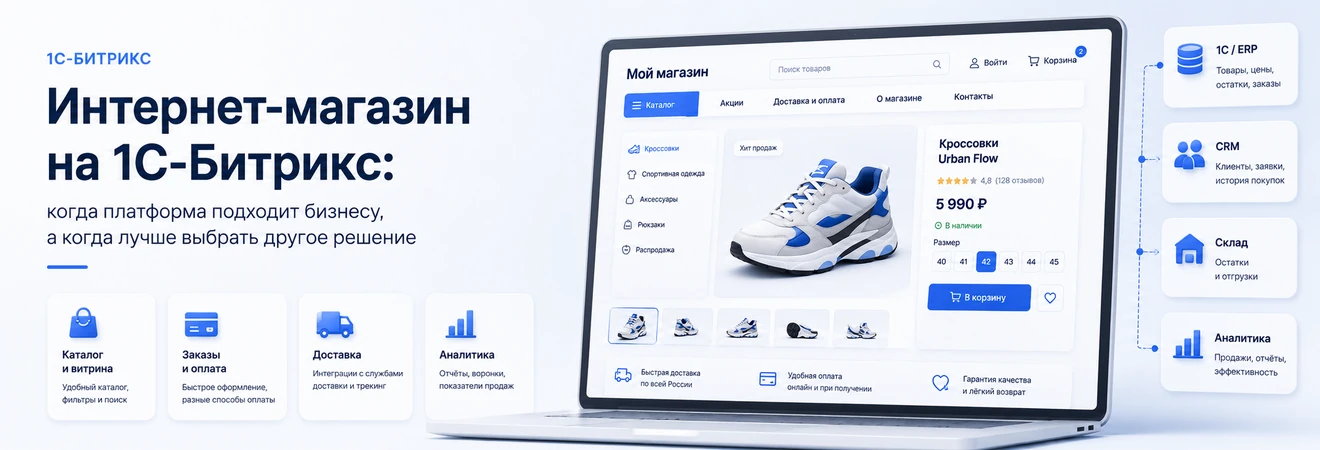
An online store on 1C-Bitrix is often considered as a reliable option for e-commerce: the platform is known on the Russian market, supports the catalog, orders, payment, delivery, integration and development of the project after launch. But the popularity of a CMS in itself does not mean that it is suitable for every business.
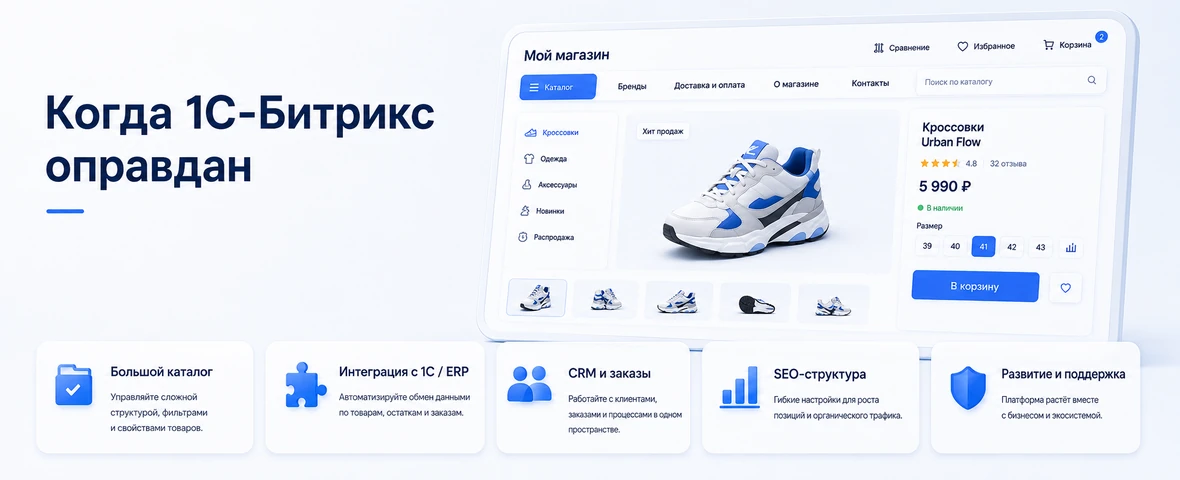
1C-Bitrix is justified where the site must work as a full-fledged trading system: accept orders, manage the catalog, exchange data with 1C, transfer requests to CRM, support the SEO structure, withstand regular improvements and remain manageable for the team. If you need a simple storefront for several products without integrations and complex logic, the platform may be redundant.
Why 1C-Bitrix is often considered for an online store
Businesses choose 1C-Bitrix not only because of recognition. The platform has e-commerce tools, an ecosystem of modules, a partner developer market, opportunities for a catalog, orders, payment, delivery, discounts, import and data exchange.
But the strength of the platform is not revealed at the time of installation. It becomes noticeable when the store begins to grow: the assortment increases, different types of prices appear, warehouse stock levels, integration with 1C and CRM, advertising campaigns, SEO pages, promotions, order statuses and regular improvements.
Therefore, the question should not be “is Bitrix good”, but “does it correspond to the current and future sales model.” For one business, this is a rational e-commerce base. For others, the instrument is too heavy at the start.
When an online store really needs 1C-Bitrix
The platform is most suitable for projects where an online store is not just a catalog on the Internet, but a working sales channel: many products, complex properties, several warehouses, updated prices, discounts, order statuses, accounting system and work of managers.
1C-Bitrix is worth considering if the store must regularly exchange goods, prices and stock levels with 1C, transfer orders to a CRM or accounting system, support SEO landing pages, set up filters, process payments and delivery, differentiate access and develop after launch.
When Bitrix may be redundant
1C-Bitrix does not need to be selected automatically. If a business sells 10–20 products, does not use 1C, does not plan complex integrations, does not develop an SEO catalog and wants to quickly test a hypothesis, a simpler solution may be more rational. In this case, launch speed, ease of administration and minimal support cost are more important.
The platform can also be redundant if there is no team or contractor to maintain it after release. A commercial CMS needs updates, module control, backups, integration testing, speed and neat improvements.
The problem is not in the CMS itself, but in the incompatibility of the tool with the task. A complex platform without described processes, data exchange regulations and support turns into an expensive storefront where opportunities exist, but they are not used or are unstable.
Product catalog: the main argument in favor of the platform
The catalog is the central part of the online store. For a small assortment, simple cards are sufficient, but as the product base grows, properties, product variants, characteristics, brands, prices, stock levels, filters, sorting, data import, SEO landing pages and display rules appear.
1C-Bitrix makes sense where the catalog needs to be designed as a system. It is important to define categories, product properties, filter logic, URL structure, metadata templates, indexing rules, and exchange with external systems in advance. If you skip this step, the store may end up with chaotic cards, an inconvenient filter, duplicate pages, and complex support.
It is important not to transfer the “as is” structure from the accounting system to the store. The product catalog in 1C is convenient for warehouse and accounting, but the buyer selects a product based on other criteria: purpose, brand, size, compatibility, price, availability and delivery.
Integration with 1C: where the real value appears
The connection between Bitrix and 1C often becomes the main argument when choosing a platform. But the value comes not from the fact of integration itself, but from a correctly designed exchange: what data is transferred, in which direction, how often, who is the source of truth and what happens in the event of an error.
In a typical scenario, goods, characteristics, prices and stock levels are uploaded from 1C to the website, and orders and customer data are transferred from the website to 1C. Then the status of processing, payment, shipment or other changes that are important to the client and managers can be returned back.
Before development, you need to describe the composition of the data: what prices to show, how to take into account warehouses, how to process product variants, what statuses are needed, how to transfer discounts and how to log exchange errors. Without this, integration formally exists, but requires manual verification.
CRM, enquiries and work of managers
The online store is connected not only with the catalog and warehouse. CRM is important for sales: orders, requests, customer data, traffic source, selected products, comments, statuses and interaction history should go there. If a store accepts an order but the manager doesn't see the context, some of the value is lost.
Bitrix can be linked with Bitrix24 or another CRM, but it is important not to reduce the task to “install a module”. It is necessary to determine what data the sales department needs: UTM tags, login page, products in the order, region, delivery method, payment, amount, status, responsible manager, repeat requests.
Good integration helps not to lose enquiries and process orders faster. Bad - creates duplicates, empty cards, manual transfers, incomplete data and a conflict between the site, CRM and accounting system.
SEO of an online store on 1C-Bitrix
CMS does not guarantee position growth, but should provide technical opportunities for promotion. For an online store, CNC, Title, Description, H1, meta tag templates, sitemap.xml, robots.txt, canonical, redirects, duplicate management, speed, mobile version and control of indexed pages are important.
Main SEO-zone e-commerce - catalogue. Categories, product cards, brands, filters and sorting can help promotion, or they can create technical garbage. For example, a useful landing page by category and property can attract demand, while uncontrolled combinations of filters can create thousands of duplicates.
When developing a store on 1C-Bitrix, SEO needs to be laid out before launch: category structure, URL rules, indexability of filters, canonical, redirects from old pages, site map, meta tag templates and technical verification of cards. It is usually more expensive to fix this after release.
Performance and scaling
1C-Bitrix can be used for large stores, but performance depends not only on the CMS. Speed is affected by hosting, caching, catalog structure, quality of templates, number of modules, filters, images, database queries, external scripts and integrations.
It’s a mistake to assume that the platform itself will solve the speed issue. Even a strong CMS will slow down if the catalog is designed carelessly, the filters work hard, the images are not optimized, there are too many modules, and the exchange with external systems is carried out without load control.
If a store plans to increase its assortment, seasonal promotions, advertising campaigns and active SEO, productivity needs to be designed in advance. Otherwise, problems will appear precisely at the moment when the site should withstand sales.
Security, updates and support
The online store works with orders, customer contacts, payments, personal data, user rights and external services. Therefore, security and support should not remain a “when something breaks” task.
After launch, you need to monitor kernel and module updates, backups, administrator access, user roles, forms, suspicious activity, order correctness, payment and delivery operation, speed and integration. Any improvement must pass the test of key scenarios: the user found the product, added it to the cart, placed an order, the data went to the necessary systems, the manager saw the result.
How much does it cost to own a store on 1C-Bitrix
The cost of an online store on Bitrix cannot be estimated only by license or initial development. The actual budget includes engineering, design, layout, programming, catalog, data migration, SEO setup, integrations, testing, analytics, hosting, support and future improvements.
The more complex business processes, the more important the cost of ownership becomes. For example, integration with 1C can be simple if the data is standard and the processes are described. But if there are several warehouses, different types of prices, non-standard statuses, partial shipments or complex discounts, the task becomes a project task.
Table: when Bitrix is justified, and when it’s worth comparing options
To avoid choosing a platform based on opinion, it is useful to evaluate specific situations. The table below helps you understand where 1C-Bitrix is usually justified, and where it is worth comparing it with an easier solution.
| Business situation | Selection evaluation | Why | What to check before starting |
|---|---|---|---|
| Large catalog of products | Rational choice | There are tools for the catalog, properties, prices, orders and store expansion | Categories, properties, filters, speed, SEO structure |
| Need integration with 1C | Rational choice | The platform is designed for the exchange of goods, orders, prices, stock levels and statuses | 1C configuration, exchange regulations, data composition, error handling |
| Simple storefront for 20 products | Not always justified | Platform capabilities may be redundant for a quick start | Budget, timing, development plans, need for integrations |
| SEO promotion is planned | May be considered | You can manage structure, metadata, URL, indexability and duplicates | Filters, canonical, sitemap, robots, redirects, speed |
| No support budget | Risky without support | The store needs updates, integration control and technical support | Who will maintain the project after launch |
| Need CRM, warehouse, payment and delivery | Rational choice | The platform is suitable for linking a store with business systems | API, modules, statuses, order scenarios, analytics |
| Need a fast MVP without integrations | Better compare options | To test a hypothesis, an easy solution may be more profitable | MVP goal, project lifespan, future migration |
Errors when developing a store on Bitrix
The first mistake is to buy a platform before describing the processes. If it is not clear how the catalog, prices, stock levels, orders, statuses, CRM and 1C are organized, development will go through constant clarification and rework.
The second mistake is making a catalog without SEO logic. If filters, properties, categories and URLs are not designed before launch, the store can end up with duplicates, empty pages, weak structure and indexing problems.
The third mistake is to launch integration with 1C without regulations. It is necessary to determine in advance what 1C uploads, what is edited on the site, how errors are processed, how often the exchange takes place, who checks orders and what is considered the source of truth.
How DevAstro designs online stores on 1C-Bitrix
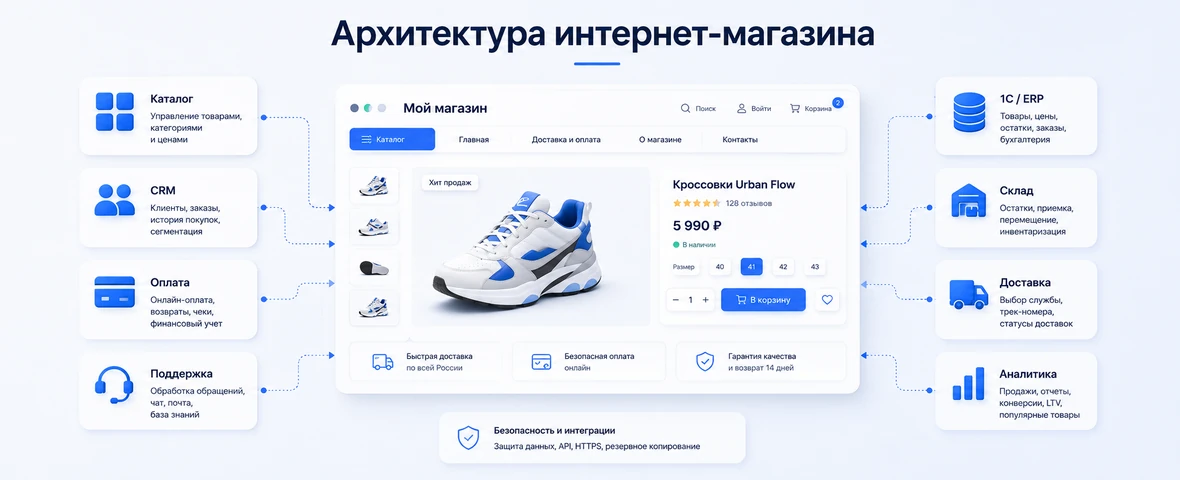
DevAstro considers a store on 1C-Bitrix not as installing a CMS, but as designing an e-commerce system. First you need to understand business processes: what products are sold, how categories are organized, where prices and stock levels come from, where orders go, what roles managers need and what integrations are important after launch.
As part of the development of an online store, the team designs a catalog, product cards, filters, shopping cart, ordering, payment, delivery, SEO structure and analytics. If the store is connected to 1C, CRM, warehouse, payment services or external systems, API integrations are separately worked out: data composition, exchange scenarios, statuses and error handling.
After launching, the online store needs technical support for the site: updates, backups, control of forms and orders, speed, security, checking integrations and improvements without chaotic edits. If the project goes beyond a typical store and requires personal accounts, a B2B portal or complex interfaces, a separate architecture may be required as part of the development of websites or web enquiries and SPA.
What's the result?
An online store on 1C-Bitrix is suitable for a business that needs not just an online storefront, but a managed trading system: catalog, orders, integrations, SEO, analytics, roles, support and development. In such projects, the platform can be a rational choice, because it covers not only the start, but also further operation.
If the task is simpler - a small catalog, a fast MVP, no integrations and a minimal support budget - it’s worth comparing Bitrix with easier solutions. This does not make the platform worse. This means that the tool must be selected according to the scale of the task.
The main selection criterion is not the name of the CMS, but compliance with business processes. If a store needs to grow, exchange data, support SEO, help managers and develop for several years, 1C-Bitrix should be considered seriously.
FAQ
When does 1C-Bitrix make sense for ecommerce?
It makes sense when the store needs a catalog, cart, orders, integration with 1C, SEO pages, manager roles and a ready admin area. It is especially useful when inventory, prices and accounting matter.
When should a business consider another approach?
If the project needs a highly custom product interface, complex B2B logic, unusual frontend behavior or a headless architecture, Bitrix should be compared with custom development before the platform is fixed.
What should be planned before development starts?
Catalog structure, product properties, filters, SKUs, prices, stock, payment, delivery, order statuses, CRM/ERP integrations and SEO category structure should be described before development.
Can an existing Bitrix store be improved?
Yes, but it should start with an audit of templates, modules, 1C exchange, performance, indexation, catalog structure, checkout and analytics. This shows whether improvements or staged rebuild are safer.
Is 1C-Bitrix suitable for B2B ecommerce?
It can be when organizations, roles, contracts, individual prices, documents and approval workflows are designed explicitly. A standard B2C template is not enough for these scenarios.
How can catalog exchange problems be reduced?
Use stable identifiers, variant rules, mandatory attributes, field ownership and a rejected-record report. Product names should never be the primary exchange key.